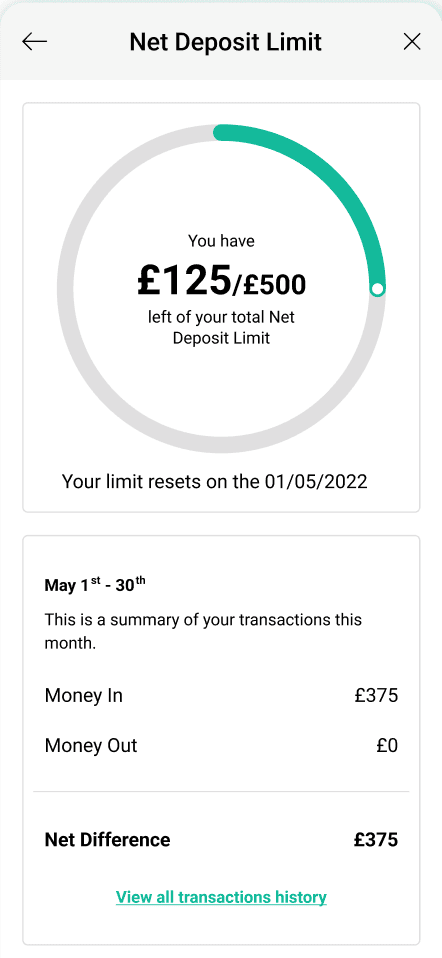
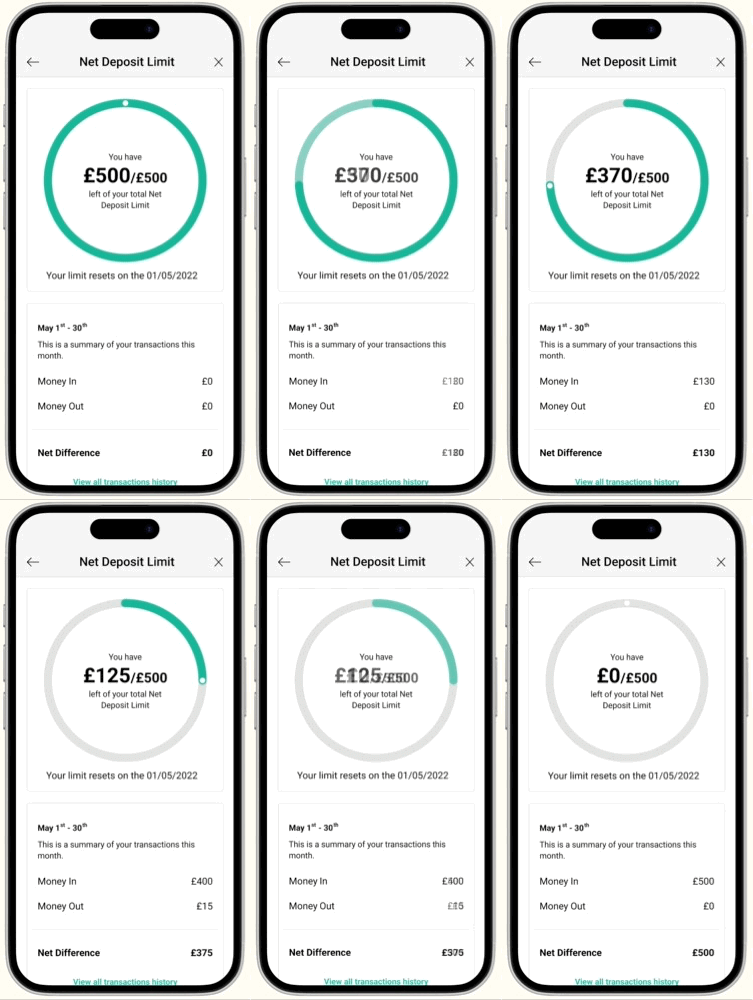
A dashboard that communicates the net amount spent during the current month with supporting information on how the tool and regulation works.
Role Overview
Responsibilities
Guided the research, design and development of user experiences from discovery to delivery of most projects within Responsible Gaming, creating seamless and safe interactions for over 18 million players worldwide.
UX team maturity
Led several projects for which I also guided and monitored the work of fellow UI and Content Writers to ensure project advances were aligned with user data, aims and strategy.
Iterative researching
Defined research purpose and scope to conduct and document user research iteratively. Used appropriate qualitative or quantitative methods to gain an understanding of consumer behaviour and expectations that would then guide our design decisions.
Cross-functional
Collaborated with teams such as data, tech and legal to ensure solutions were within the scope of business objectives, technical feasibility and international licence regulations. Learnt to anticipate the needs and priorities of different stakeholders.
Tools: Figma, UserTesting & Dovetail
Figma was used to create and collaborate on prototype designing. UserTesting was used to test these prototypes and gather insights. Dovetail was used to analyse and communicate the research to stakeholders.
Agile work
Adapted to an agile, fast-paced environment through effective time and workload management over multiple projects of different sizes on Jira.
Net Deposit Limit Tool Dashboard
Research shows people tend to want to complete processes and steps. As this tool is intended to help players manage their spending amounts, we wanted to use this research and design a dashboard that discourages users from spending. This is why the graph empties out in an anticlockwise direction, the positive, green reinforcement getting smaller as users spend more money.
The dashboard also has drop-down boxes with relevant questions based on those raised by users during user testing.

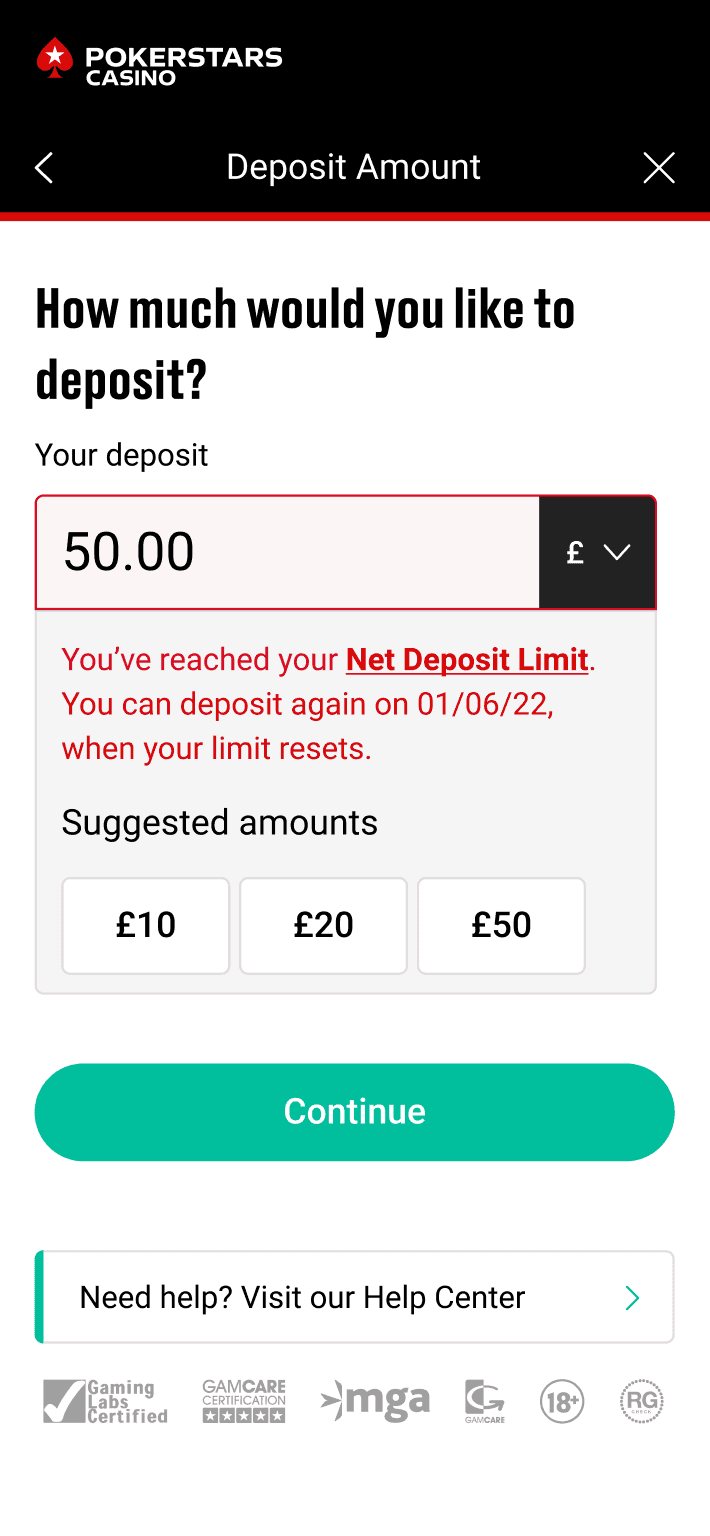
Reaching the Net Deposit Limit
These screens illustrate the journey a user could have when wanting to deposit money and having reached their limit. We had to be very careful with the language we used here because this is a moment in which the user could feel frustrated or vulnerable.
It was very rewarding to be able to work with stakeholders to develop a method to mitigate unhealthy gaming by raising awareness and giving the player an opportunity to evaluate their spending and gaming - Turning and frustrating experience into an introspective one.
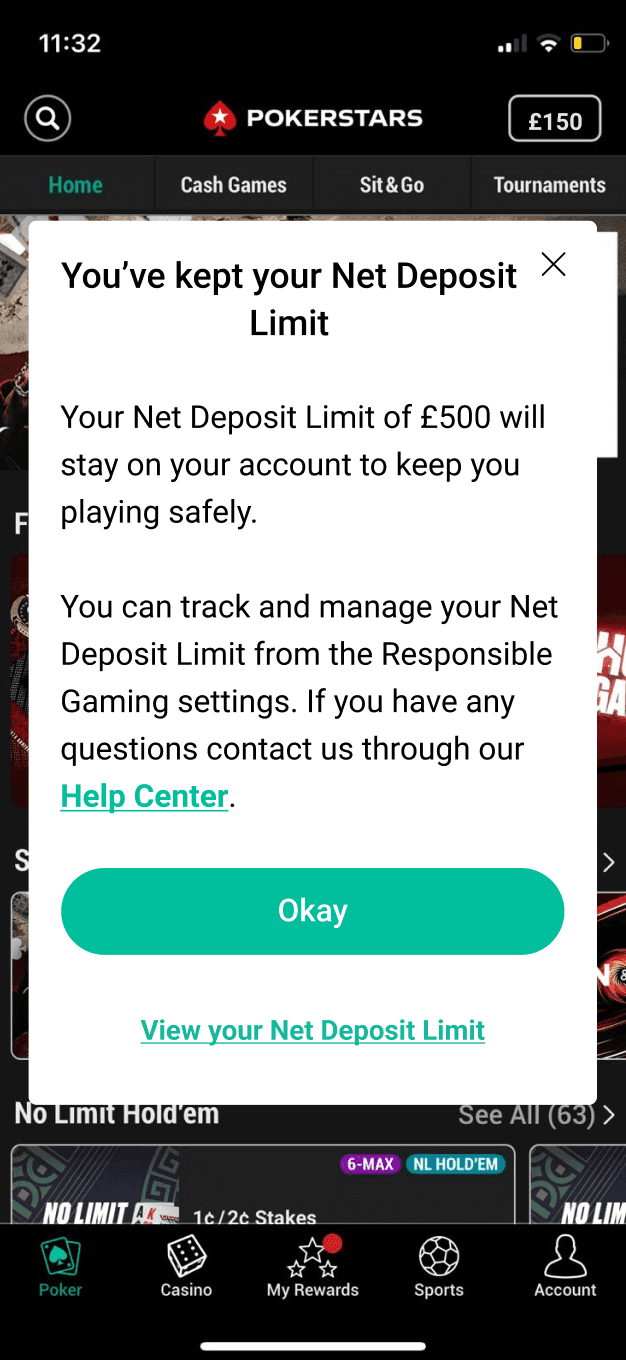
Turning 25
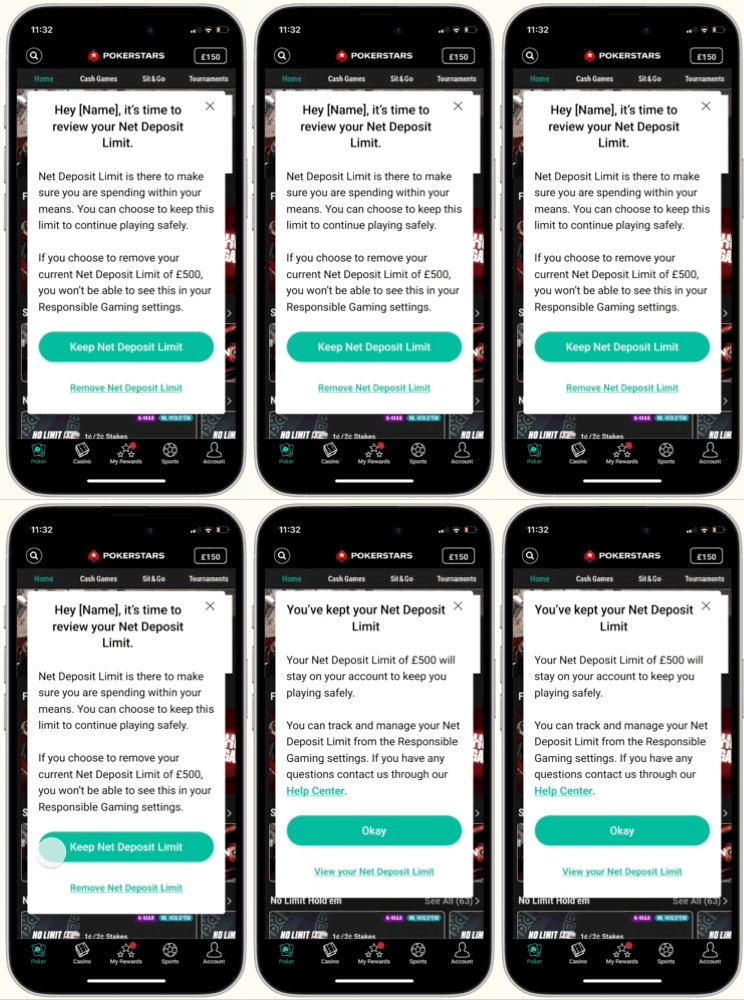
These are the pop-up messages that the player would receive when turning 25 and the limit not being a requirement any more. Safer gaming practices were applied here again by having the option to keep the limit as a primary CTA.
The challenge with these screens was that because users rarely read pop-ups, we had to economise and evaluate every single word to make it as concise as possible.
Project Process
Defined the scope
Analysed and questioned the regulation with the legal team to identify extreme cases and the constraints of the brief. Talked to Business Intelligence to identify and quantify the players that would be affected.
Used what was already there
Cross-company teams had already worked on this regulation for other licences so we used their reports to understand the research that had already been done. Competitor analysis helped identify journeys and designs that already existed.
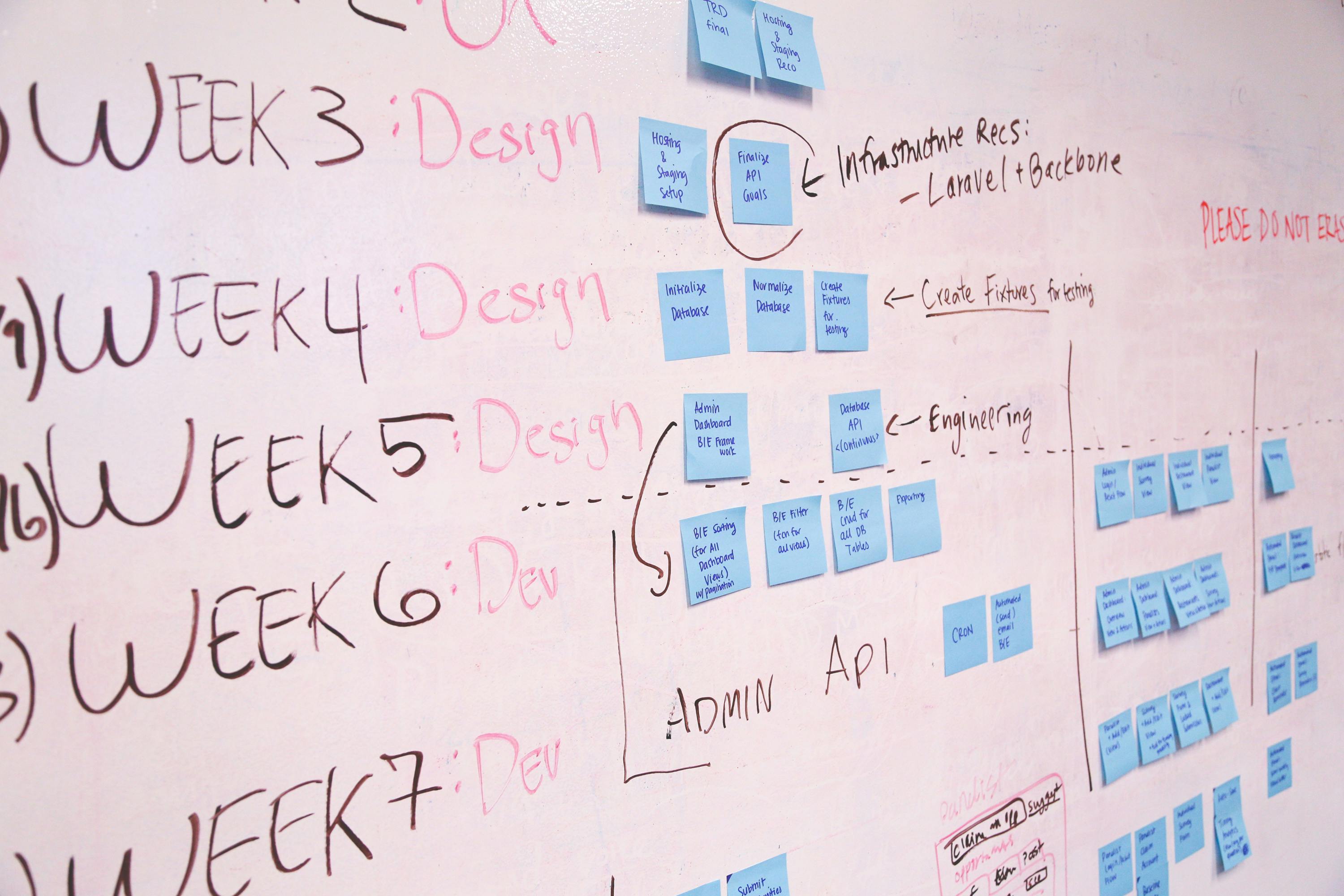
Journey mapping was a great method to identify opportunities and minimise pain points at different stages of the player's journey. Especially across so many touch points.
Research & Discovery

Freedom of use: Players expect to be able to change the limit freely.
Autonomy: Transparency is needed on how the limits have been calculated.
Ease of Use: Confusion regarding the similarities and relationship of deposit limit tool and affordability tool.
Support & assistance: Further information needs to be easily accessible.

Design - Test - Report - Present - Repeat
We followed this approach to quickly map out user needs and expectations, understand the scope of the deliverables, and progressively feedback to our stakeholders the status of the project.
Methodology
2 rounds of Unmoderated Usability Testing
7 users per test, target demographic
Qualitative testing to evaluate user expectations, attitudes and performance of our designs
2 rounds of testing
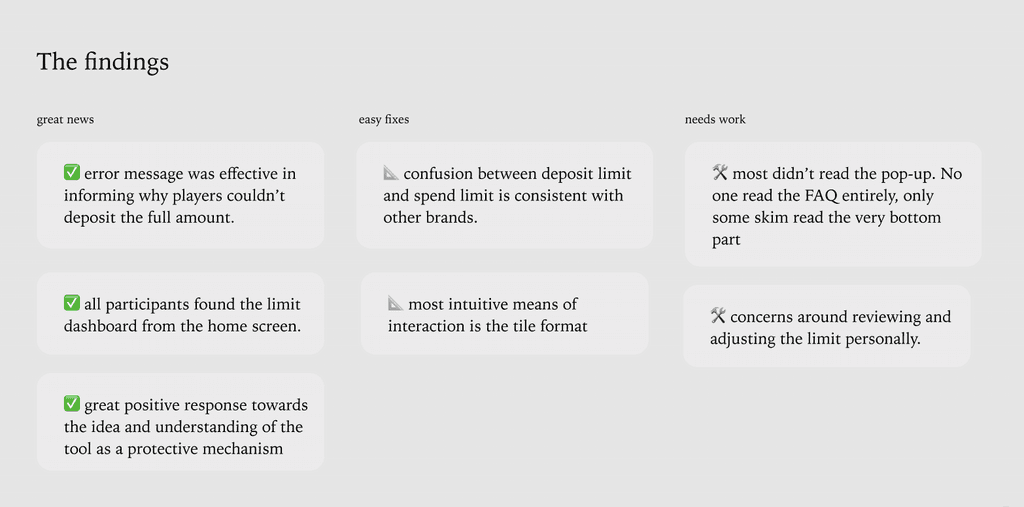
The first round of testing was to evaluate the first impressions and behaviours towards the limit, to test an initial pop-up design with the dead-end deposit flow and if users understood what the spend limit was.
The second round of testing, we were able to anticipate user questions and concerns, and focused on the design of the graph progressively and the interactive instances.
Internship Responsibilities

Ellina Morits - Principle UX Designer & Line Manager
"She is an eager learner and always seeks feedback on her work. She built close relationships with other UI and UX designers, ensuring collaboration and living the company value of ‘winning together’. Giorgina delivers on time, works collaboratively and is always there to help her colleagues."
07/07/22
Nathan Wood - UX Architect & Mentor
"It was clear from very early on that she had a true passion for the field of UX and it really showed with the effort that she put into her testing and reports. I believe her UX knowledge easily exceeds any baseline of what I would have expected from an intern and It was just so great to see someone so passionate about learning UX to the extent that she did. Love for the field aside, Giorgi is exceptionally kind-natured, polite, and hardworking and will no doubt be a great asset to her future employer."
02/12/22